
Atomic Ecology Meets — Dr. Victor Deklerck, World Forest ID

Updated: Jul 10
Where Did This Tree Come From? Isotopes as a Lie Detector for Timber
Most of these Atomic Ecology Meets have featured postdocs, students and professors — people firmly in the academic world. This one's a little different. Last week I sat down with Dr. Victor Deklerck, Director of Science at the non-profit World Forest ID, to talk about isotopes in action solving som e'real world' challenges. (cheers to Mike Seed at Elementar, who first pointed me their way.)
Whats a 'real world' problem? Well, somewhere between 10 and 30% of timber in global trade is illegally harvested — and in the tropics that figure can climb toward 90%. A 2017 estimate put the illegal timber trade at around $150 billion a year, making it the biggest natural resource crime going. Most people don't even realise "wood" can be contraband.
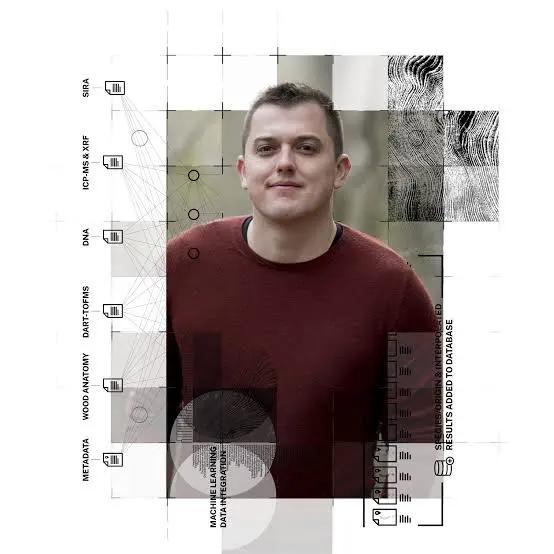
There are really two questions you can ask of a suspicious plank: what species is it, and where did it come from? Victor cut his teeth on the first — building chemical fingerprint databases from wood collections (gorgeously called xylaria, libraries of wood) with the US Fish & Wildlife forensic lab in Oregon. World Forest ID tackles the much harder second question: origin.
And the timing matters. The EU has just swapped its Timber Regulation for the broader European Deforestation Regulation, extending the rules beyond wood to soy, cattle, palm oil, cacao, coffee and rubber — and banning imports from any land deforested after 31 December 2020. Suddenly every importer needs to prove exactly where their product grew. Which is where the chemistry comes in.
The recipe: collect samples with GPS-logged provenance, measure their stable isotopes (hydrogen and oxygen are the spatial superstars) alongside a suite of trace elements, then let a Gaussian process — "kriging on steroids," as Victor puts it — interpolate a map between sampled points, complete with an uncertainty estimate. Stack those isoscapes, run a Bayesian probability calculation, and you get a map that says: plausible, or not plausible.
Does it work? Their flagship project, funded by the UK government to police the post-Ukraine-invasion ban on Russian and Belarusian wood, sampled ~4,400 trees across Eastern Europe in six months. When Russian birch started arriving relabelled as Finnish, then Kazakh, then Turkish (a colleague spent six months in Turkey and found six birch trees), the isotopes kept catching the laundering. It's all published, open access, in Nature Plants - https://www.nature.com/articles/s41477-024-01648-5.
Best of all, none of this lives behind a private wall. World Forest ID runs an online platform where any lab can test samples against the reference models — already used by the Belgian and Finnish governments and private companies alike.
If a lightbulb's going off — you've got samples, a supply-chain question, or just curiosity — they're a friendly bunch: info@worldforestid.org. And if the isotope theory underneath all this is what's tugging at you, that's rather my department; the courses are on the site.
Comments